
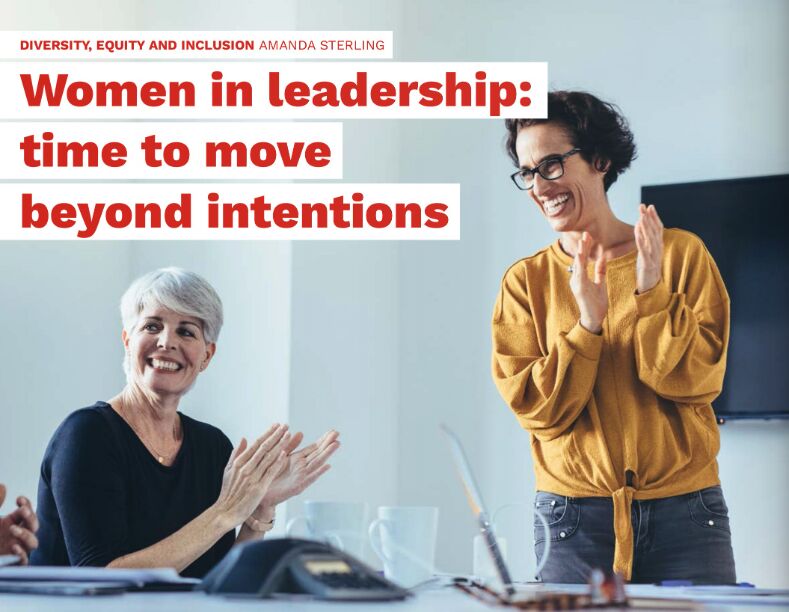
In this article, I share insights from my latest research into where organisations should focus their attention to increase the representation of women in leadership. Read it here: HRNZ – Autumn 2026 (Vol. 31 No. 1) Celebrating HR excellence (1)
 amandas
The Four Factors: Focus Group Summary
This focus group brought together six women leaders from diverse sectors including healthcare, finance, utilities, and corporate services to explore what supports women’s career advancement into leadership roles. The conversation revealed how these women were claiming their unique perspectives and experiences as women in leadership and how their voices were then actively valued and supported through their careers and by their leadership teams.
Download the focus group summary – Four Factors Focus Group Summary 9th September 2025 (2)
Women in Leadership: Insights to Impact 2026 Summary Report
Explore the 2026 Four Factors having the most positive impact on women’s careers into leadership.
Download the Women in Leadership Insights to Impact 2026 Summary Report
The path to more women in governance

Gender-balanced boards improve decision-making and risk oversight. Why has the private sector yet to catch up?
Originally published by the Institute of Directors, 6th March 2026. Access the article here.
Written by Dr Amanda Sterling, Leadership Consultant
The evidence has been clear for years: boards with greater gender diversity make better decisions, are more attuned to risk and deliver stronger organisational outcomes. Yet in Aotearoa New Zealand’s private sector, women hold just 31% of director positions on NZX-listed companies – a gap the public sector closed years ago.
This International Women’s Day (8 March), I invite boards to reflect on how we can better support women into governance and recognise the benefits. With research consistently pointing to systemic barriers rather than a shortage of capable women, the question for boards is no longer whether to act, but how.
Research shows gender-diverse boards enhance decision-making (Wiersema & Mors, 2023), take a broader view of risk and respond more strongly to corporate social responsibility. These factors can positively influence financial performance and share price (Li et al., 2022).
Yet in New Zealand, the picture remains uneven. As of the last measurement (December 2024), women hold 52.1% of public sector board roles – an equality milestone maintained for five consecutive years. Meanwhile, women represent only 31% of director positions across NZX-listed companies.
The IoD’s Director Sentiment Survey shows 44% of members believe shareholder or member activism will affect their board or organisation. This suggests growing pressure for boards to consider whether they represent a broad range of experiences and create conditions for the full range of talent to step forward.
The public sector’s achievement of gender parity on boards did not happen by accident. It was the result of deliberate government targets, proactive nominations and a long-term commitment to gender balance. As Minister for Women Hon Nicola Grigg noted when the 2024 board composition results were announced: “It’s taken a deliberate and coordinated effort to achieve this result.”
The private sector, by contrast, has moved more slowly, with many firms lacking equivalent diversity mandates or structured processes for intentional recruitment. The gap between 52% and 31% is not a gap in the quality of women available – it is a gap in process, expectation and accountability.
Barriers in the pathway to governance
In 2024, I led research with the Ministry for Women interviewing women serving on boards across New Zealand to map pathways into board roles. The experiences of these women were candid and consistent with international evidence. The barriers women face are not primarily about capability or confidence – they are structural.
Board recruitment in the private sector still relies heavily on informal networks and personal referrals. As one of the women interviewed put it: roles are often introduced through existing connections, and those who are not part of those circles simply miss out – regardless of their experience or skill.
Research by Young et al. (2024) confirms this: recruitment through social networks systematically disadvantages women who are not embedded in those networks, and appointment decisions often reflect ‘socially constructed ideologies’ rather than a clear-eyed assessment of governance capability.
A second barrier is the narrow definition of what ‘board-ready’ looks like. Boards that privilege C-suite, finance or legal backgrounds are, in practice, recruiting from pools where women remain underrepresented. Decision-makers favouring current or former CEOs can inadvertently exclude a significant proportion of highly capable women (Young et al., 2024).
Broadening what counts as relevant experience –including expertise in people, strategy, sustainability and risk – is not about lowering the bar. It is about raising the quality of the board.
The boardroom experience
A third barrier is more subtle: the additional labour women carry to establish and maintain their credibility once they are in the room. The women I interviewed described having their voices overlooked, needing to work harder to be taken seriously, and navigating expectations unrelated to governance capability.
Research by Trzebiatowski et al. (2023) describes this as the ‘warmth-competence dilemma’ – a double bind where women face scrutiny for being either too assertive or not authoritative enough. This is not a personal problem for individual women to manage; it is a culture issue for boards to address.

Trina Tamati – the Kindness Collective Foundation (board member), College Sport Auckland (board director) and Global Youth Sevens (board advisor) – captured this dynamic well: “You can say the same thing five times as a female, and it won’t be heard. A male can say the same thing once and somehow it has cut through.” What particularly stood out from these interviews was a recognition that the value these women brought to their respective board tables was precisely because of their differences.
Research by Wiersema and Mors (2023) backs this up –- finding that women on boards improve decision-making not despite their differences, but because of them.

Jennifer Caldwell – Partner and former board chair at Buddle Findlay – noted Buddle Findlay’s progress in achieving a board of four women out of seven members. Greater diversity followed a shift to a broader partner performance evaluation process. Highlighting how – when boards create the conditions to recognise a more rounded range of contributions – the people who bring those contributions become more visible.
My recent Women in Leadership: Insights to Impact survey, with results from 410 women across Aotearoa New Zealand, reveals that sponsorship was one of the four factors with the strongest impact on progression into boards roles.
Sponsorship is where senior leaders actively advocate for women, put their names forward and open doors. It is distinct from mentoring. Mentors provide advice; sponsors provide access. In a governance context, where shoulder-tapping remains one of the most common appointment pathways (IoD Directors’ Fees Report), sponsorship is not a nice-to-have. It is a primary mechanism through which board candidates become visible.
What boards can do
The evidence points clearly to where boards and those who recruit for them can make the most difference. None of it requires waiting for the pipeline to fix itself.
Broaden recruitment beyond your existing networks
If your board has consistently recruited through personal referrals and existing connections, you are not accessing the full depth of talent available. Active outreach through governance registers, diversity-focused search firms and sector networks will surface candidates who are equally capable but less visible through informal channels.
Rethink what ‘board-ready’ means
Boards that define experience too narrowly will continue to reproduce themselves. Consider whether the skills your board needs in the next five years – in areas such as people strategy, technology, sustainability or stakeholder engagement – might be held by people who have not followed the traditional executive path. This is about asking whether your current standards are genuinely aligned with your future governance needs.
Sponsor, not just mentor
If you are a board chair or experienced director, consider who you are actively opening doors for. Mentoring is valuable; sponsorship is transformative. For women who have the capability but lack the visibility, active advocacy from respected governance leaders can be the difference between being considered and being overlooked. This means putting names forward, making introductions and using your own network on behalf of others.
Create conditions where different voices are heard
Boards that actively shape their culture – through induction practices, chairing style and the norms they model – are more likely to realise the full value of diverse perspectives. This includes attending to whether all directors have equal opportunity to contribute and whether the burden of establishing credibility falls disproportionately on some members. Where boards invest in evaluation and self-reflection, they tend to perform better and to attract a wider range of capable candidates.
International Women’s Day is a moment to reflect – not just on how far we’ve come, but on the distance still to travel. In New Zealand, we have demonstrated through the public sector that gender balance on boards is achievable when it is prioritised deliberately. The question for the private sector is whether boards are willing to apply the same level of intentionality.
Leadership to governance: Intentional pathways for women

Opportunity isn’t enough. Women’s progress depends on visible pathways, development support and structural change.
Originally published by the Institute of Directors, 12th November 2025. Access the article here.
Written by, Judene Edgar, Principal Governance Advisor, IoD, and Dr Amanda Sterling, Leadership Consultant
Progress for women in leadership and governance has never been driven by chance; it’s built through insight, intention and systemic change. As researchers and practitioners, we’ve each explored different parts of that journey – Amanda Sterling through her work on what enables women to reach and thrive in leadership roles, and Judene Edgar through her study of how people enter and develop in governance. Together, our research highlights a common truth: opportunity alone isn’t enough. Without intentional structures, support and visibility, women’s progress stalls long before they reach the boardroom.
Sterling’s Women in Leadership: Insights to Action survey, published in 2025, gathered insights from 212 women across Aotearoa New Zealand to identify what has the most positive impact on women’s progression into leadership. The results were clear: supportive managers, partner support, access to leadership development and flexible work were the strongest enablers of women’s career progression. These findings have already sparked valuable discussions – from HRNZ and Global Women to business leaders wanting to strengthen internal pipelines.
Edgar’s 2025 master’s research examined pathways into governance, the role of education and the barriers that prevent broader participation. The study found that mentoring, sponsorship and accessible training are critical for first-time directors, yet these supports remain inconsistent and often under-resourced. It also reinforced that governance is a distinct discipline requiring ongoing learning – not a destination reached after an executive career, but a practice continuously developed and refined.
Viewed together, the two bodies of work reveal clear connections. The conditions that help women succeed in leadership are often the same ones that enable them to thrive in governance: networks that open doors, managers who act as sponsors and cultures that value learning and inclusion. Both studies also challenge the notion that leadership progression happens organically. Few women are “tapped on the shoulder” for governance roles unless they have visibility or connections, and explicitly active support is needed from managers to counter barriers women face on their path to leadership.
The 2025/26 Directors’ Fees Report reinforces this, showing that shoulder-tapping remains one of the most common appointment pathways, particularly in private and not-for-profit organisations. Because leadership experience often shapes who is visible and considered for governance, barriers to women’s advancement in leadership effectively become barriers to board participation, especially where boards are looking for executive level experience or traditionally favoured expertise such as finance and law. That’s where intentionality matters – from workplaces identifying emerging leaders and supporting their leadership aspirations, to boards broadening recruitment beyond familiar networks.
Intentionality isn’t about quotas; it’s about consciously designing systems that notice and nurture potential. As Edgar observes, women can’t aspire to what they can’t see – and they can’t step up if barriers are in the way. Notably Sterling’s doctoral research highlighted the consequences for women when they can’t be what they can see – resulting in internalised barriers where women lack confidence or perceive a lack of capability because they can’t see how their skills are recognised and valued. A shared insight across both projects is the importance of transparency. When leadership support and board development is visible – discussed, reported and publicly valued – they become part of organisational culture rather than a personal pursuit.
Edgar’s research highlighted international models where organisations disclose director training and board evaluations in their annual reports, normalising development as a core governance responsibility. Similarly, Sterling’s survey found that women were most positive about workplaces that made leadership pathways visible – with clear frameworks showing how capability builds and where opportunities can be fully realised. Both point to the same conclusion: support and development must be intentional and transparent if we want to sustain progress.
While individual action remains important, neither study suggests that women alone should carry the responsibility for advancing gender equity. Systemic change is essential – in recruitment, recognition and reimbursement. Edgar’s findings call for stronger expectations around mentoring, evaluation and making learning opportunities more accessible, while Sterling’s data highlights the importance of partner and manager support in enabling women to participate fully in leadership.
Encouragingly, there are signs of progress. Within the IoD, work is under way to make governance education more accessible and to build pathways for under-represented groups. Across sectors, many organisations are also re-examining how they identify, develop and sponsor women for both executive and governance roles – recognising that talent pipelines don’t build themselves and that equitable support strengthens the leadership and governance pool.
The alignment between these two research projects underscores the need for greater collaboration across leadership and governance systems – from HR professionals to directors, educators and policymakers. By connecting insights from leadership and governance, we can better understand where the gaps lie and how to design systems that close them. While this seems like yet another complex challenge for directors to grapple with, the intersection of research and practice shows a way forward – one where we get curious about the barriers that still exist for women and work together to amplify what’s working.
Sterling will relaunch her Women in Leadership: Insights to Impact survey in January 2026, building on the 2025 findings to further deepen understanding of what most effectively supports women’s career and leadership progression. The expanded survey aims to reach around 1,000 participants across industries, age groups and ethnicities, creating a stronger evidence base to inform practice – including how to better connect leadership support with governance pathways. Women in leadership roles (or on the pathway there) can register their interest now.
As directors, we often ask how to future-proof our organisations. Perhaps the same question should apply to leadership itself. If boards are serious about capability, diversity and resilience, they must look further upstream to the systems that support and sustain women leaders. The evidence is there; the challenge now is to act on it – collectively, intentionally and transparently – to build a governance ecosystem that reflects the full breadth of talent in Aotearoa.
Re-birthing new life to leadership – Research Report
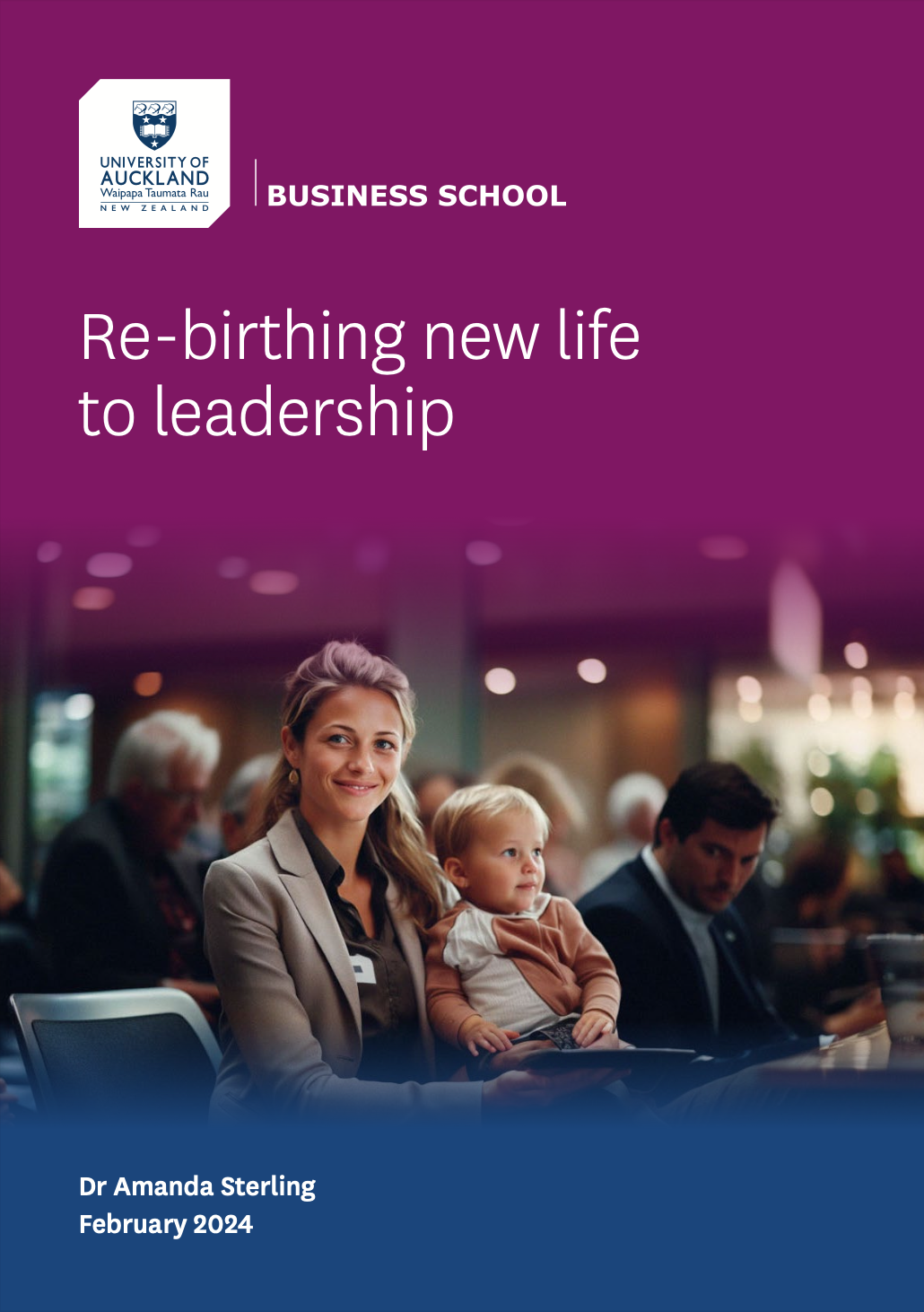
Access the summary of Amanda’s PhD research.
Organisations are struggling to recruit and retain women in leadership, and women are struggling to stay.
While current approaches to address this are well-intentioned and have made some inroads, this world-first research demonstrates how recognition of embodied experiences within leadership (i.e. performances, experiences, and emotions associated with our bodies) could lead to greater recruitment and retention of women in leadership.
These are workplaces where people feel they can authentically bring the diversity of their human, and vulnerable, experiences into their leadership roles and where women (especially mothers) dt just survive, but thrive.
Drawing on PhD research conducted by Dr Amanda Sterling, which explores the experiences of embodied mothers in leadership (i.e. pregnancy, birth, breastfeeding, and care of children, and the embodied strategies that women engage in to manage these experiences), this report highlights:
- the additional labours mothers in leadership experience;
- how recognising the experiences, performances, and emotions associated with our bodies can lead to more empowered leadership;
- possibilities for more inclusive, connected, and purposeful leadership when we do; and
- the pathway forward for organisations, and the leaders within them, to apply this research in increasing representation of women in leadership.